The "Chatbot Hangover"
In early 2023, thousands of enterprise organizations rushed to bolt generative AI chatbots onto their customer portals and internal wikis. Two years later, the corporate landscape is littered with decommissioned chatbot pilots.
The failure was not because large language models lack intelligence. It was an architectural mismatch.
Business operations do not need a polite conversationalist that writes sonnets. They need an automated system that reconciles an incoming $42,000 equipment parts invoice against an active purchase order, verifies sales tax compliance across county lines, flags discrepancies, and registers the validated record in the enterprise ledger.
The Deterministic Agent Architecture
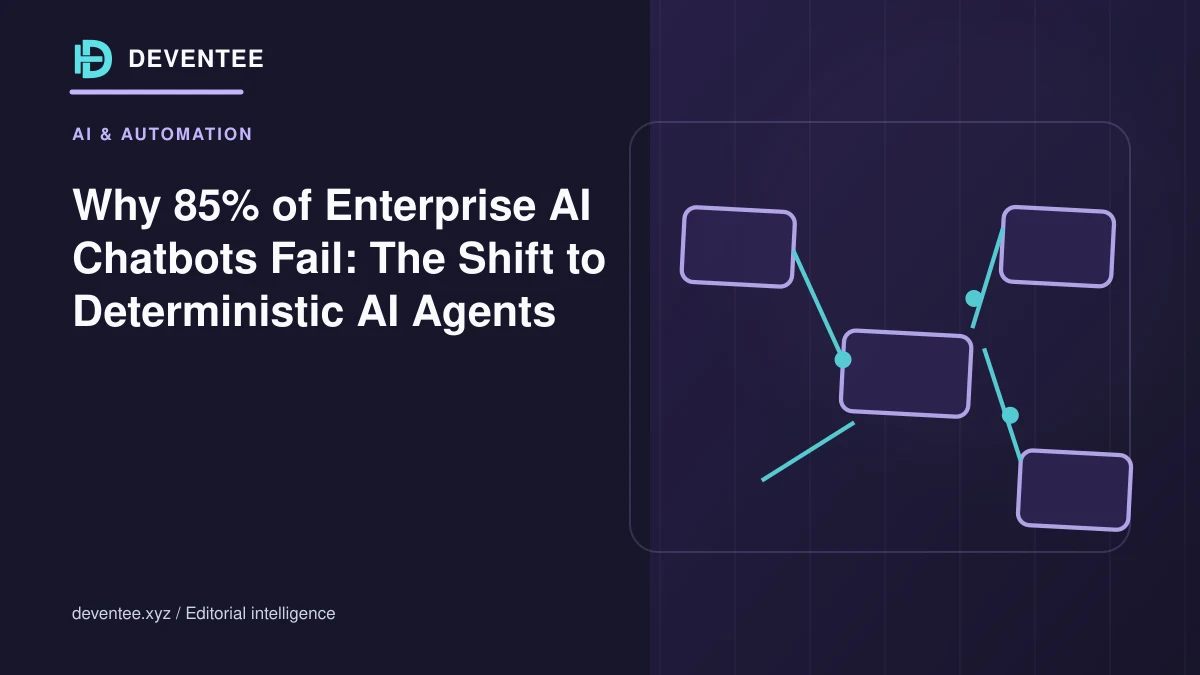
To make AI safe for core business engineering, we decouple reasoning from execution. The model is used exclusively for fuzzy semantic extraction and intent classification; deterministic code handles all execution, database mutations, and validations.
Deterministic Agent Pipeline:
[ Raw Document / Event ] ──> [ LLM: Structured Extraction ] ──> [ Zod Schema Validation ]
                                                                        │
                 ┌──────────────────────────────────────────────────────┴───────────────┐
                 ▼ (Valid Schema)                                                       ▼ (Invalid)
[ Finite State Machine Engine ]                                            [ Human Review Queue ]
                 │
                 ▼
[ Authorized Tool Execution: DB / API ] ──> [ Cryptographic Audit Log ]
The Core Agent Runtime
Here is how we structure an operational tool in TypeScript with strict runtime Zod validation:
import { z } from &class="text-[#6a9955]">#class="text-[#b5cea8]">039;zod&#class="text-[#b5cea8]">039;;

export const ProcessInvoiceTool = {
  name: &class="text-[#6a9955]">#class="text-[#b5cea8]">039;process_vendor_invoice&#class="text-[#b5cea8]">039;,
  description: &class="text-[#6a9955]">#class="text-[#b5cea8]">039;Validates and records an authorized equipment vendor invoice&#class="text-[#b5cea8]">039;,
  parameters: z.object({
    vendorTaxId: z.string().regex(/^\d{class="text-[#b5cea8]">2}-\d{class="text-[#b5cea8]">7}$/, &class="text-[#6a9955]">#class="text-[#b5cea8]">039;Must be a valid EIN&#class="text-[#b5cea8]">039;),
    purchaseOrderNumber: z.string().min(class="text-[#b5cea8]">5),
    lineItems: z.array(z.object({
      partNumber: z.string(),
      quantity: z.number().int().positive(),
      unitPriceUsd: z.number().positive(),
    })),
    subtotalUsd: z.number().positive(),
    taxAmountUsd: z.number().min(class="text-[#b5cea8]">0),
    totalAmountUsd: z.number().positive(),
  }),
  execute: async (input: z.infer<typeof ProcessInvoiceTool.parameters>) => {
    class="text-[class="text-[#6a9955]">#6a9955]">// Deterministic validation: verify that line items sum up exactly
    const calculatedSum = input.lineItems.reduce((acc, item) => acc + (item.quantity * item.unitPriceUsd), class="text-[#b5cea8]">0);
    if (Math.abs(calculatedSum - input.subtotalUsd) > class="text-[#b5cea8]">0.01) {
      throw new Error(class="text-[#ce9178]">`Mathematical mismatch: Line items sum to \${calculatedSum}, invoice claims \${input.subtotalUsd}`);
    }
    class="text-[class="text-[#6a9955]">#6a9955]">// Perform database insertion in an isolated transaction
    return await recordValidatedInvoiceInERP(input);
  }
};
3 Rules for Production Enterprise Agents
- No Free-Form Execution: An agent must never have direct write access to a database without schema constraints and transaction rollback boundaries.
- Deterministic State Guards: Agents cannot transition from "Diagnostic" to "Payment Dispatched" without passing through an explicit "Manager Authorization" step.
- Comprehensive Audit Logs: Every token generated, tool invoked, and response received must be saved with immutable timestamps and correlation IDs.
Conclusion
The future of enterprise software is not a chat bubble in the bottom corner of your screen. It is quiet, deterministic background agents that eliminate thousands of hours of manual swivel-chair data entry without making a single mistake.